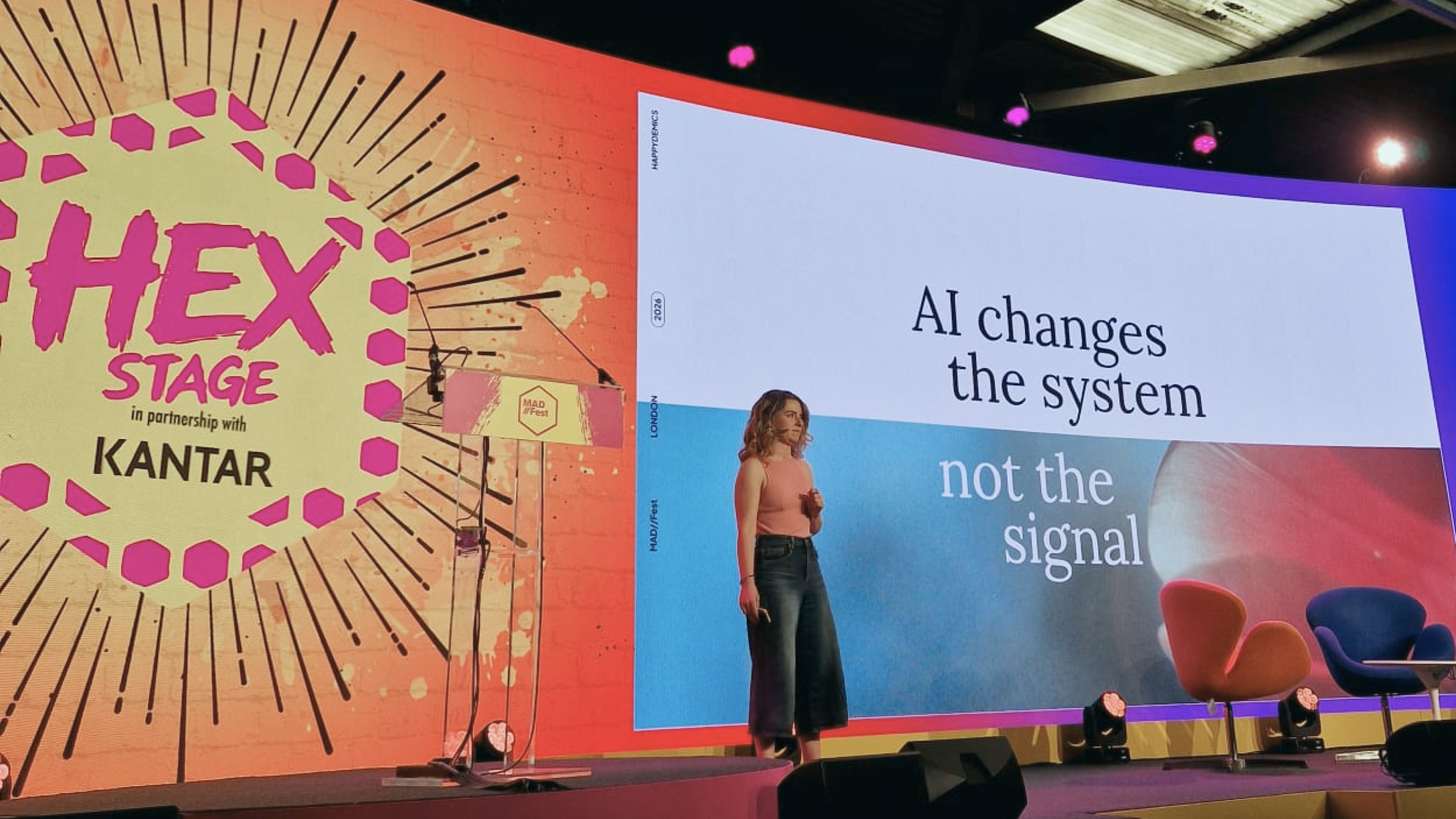
I use AI agents every day. They draft for me, summarize for me, plan my trips, and sometimes even offer a kind of listening at hours when nobody else is around to do it. I won’t pretend otherwise: it’s become useful.
But there’s something I notice more and more, and I’d rather name it than ignore it. I ask an agent a question, it hands my own thinking back to me, slightly better phrased. I approve of the answer, it reinforces the approval. Without quite realizing it, I end up circling inside a very well-optimized version of my own biases.
This isn’t a critique of the technology. It’s the actual starting point of what I want to talk about here: the machine isn’t the problem. The signal we feed it is.
The real risk isn't that AI fails
Right now, agents are adjusting bids, rotating creatives, reallocating budget, thousands of times a second, faster than a cup of coffee cools down. That’s genuinely impressive, and it will keep getting more so. But an agent has no inherent sense of what’s actually worth chasing. It pursues whatever goal it’s been given, with remarkable efficiency — including when that goal is the wrong one.
If a campaign is built for awareness, measuring clicks because they’re easier to read on a dashboard doesn’t save time. It optimizes, beautifully, toward the wrong destination. The risk I actually take seriously isn’t that AI gets it wrong. It’s that it succeeds, relentlessly, at the wrong thing.
What an agent still can't do
An agent doesn’t doubt something before the data proves it right. It doesn’t sense that an idea might work before it can be justified in a spreadsheet. That instinct — to question, to notice something feels off, to imagine something could be better before you can prove it — is still entirely ours. And it’s exactly where growth starts.
I think humans feel this too, even without naming it. They’re drawn to what feels a little imperfect, a little real. They don’t just want the finished ad; they want a sense that somewhere behind it, someone actually wrestled with an idea. As media buying becomes more efficient thanks to AI, that’s precisely where competitive advantage moves: into creativity, into whatever makes someone feel something true.
There’s a reason recall is where I always start. Before you can claim any shift in perception — image, preference, consideration — you first need proof that something landed at all. Recall is that proof. It’s the first honest signal, the one that tells you communication actually happened before you go looking for what it changed.
We’ve measured brand growth for close to 4,000 brands across 75 markets, and one thing keeps surfacing in our data: between 2023 and 2026, ad recall hasn’t collapsed the way everyone predicted. It’s actually risen: +9 points in Europe, +8 in North America, +14 across APAC. People do remember.
What makes recall useful beyond that first check is its consistency. Measured the same way across CTV, audio, DOOH, social, in-game, it becomes a common thread running through an increasingly fragmented media mix — a way to read the whole picture instead of judging each channel in isolation.
The real question was never whether they remember. It’s what happens after, because a memory alone doesn’t build a brand. A memory that turns into emotion, and an emotion that turns into action, does. When people connect emotionally with a creative — through interest, perception, or likeability — that’s consistently where we see the strongest lifts in brand image, consideration, and purchase intent. That correlation holds across markets. Efficiency gets you to people. Creativity gives them a reason to stay.
The signal doesn't wait for the campaign to end
I saw this play out clearly with a partner, Lenovo, running a campaign in Sweden during a major international football tournament, mixing physical and digital media. They tracked brand lift live, simultaneously, across three channels, with partners like Adform and TikTok at the table. What struck me wasn’t just that they could see which audiences and creatives were resonating mid-flight, or that they adjusted while the budget was still moving instead of waiting for a post-mortem three weeks later. It was that everyone in the room — brand, agency, media partners — was looking at the exact same number, at the exact same moment. Nobody was there to defend their own slice of the dashboard. They were reacting, together, to the same piece of reality.
That’s what in-flight measurement actually buys you: not just faster optimization, but a shared, live understanding that lets a whole campaign course-correct in real time instead of coasting to whatever the plan said on day one.
What a shared signal quietly undoes
The more I sit with the gaps I mentioned earlier — between exposure and intent, between spend and return — the more I think the real work isn’t closing them somewhere in the media-buying stack. It’s un-siloing the people sitting around the table. As long as every stakeholder is optimizing their own piece of the mix against their own proxy metric, everyone can be individually “winning” while the brand itself goes nowhere.
A shared truth changes that math. When creative and media are finally reading the same live signal, the wall between them stops making sense, because there’s no longer a separate story for either side to defend.
What I'd actually like us to build
A couple of weeks ago at Cannes, Sir John Hegarty told brands to stop behaving like advertisers and start behaving like a movement — a song, a film, an idea. I think he’s right. But I’d add: you can’t build a movement out of six people reading six different dashboards. You build it out of people who’ve agreed, at least for the length of a campaign, on what’s actually true.
To unlock that bold, creative energy, we need to change the input. Because when
everyone : brand, agency, media partners, and creative, realigns around the same
human signal,LIVE, two things happen.
First thing is: We UN-SILO our industry.
As the media ecosystem becomes more fragmented, consolidation becomes just as important as optimisation. Every stakeholder is improving performance within their own part of the mix, but brands still need one consistent understanding of how all those efforts are shaping perception. But a shared truth creates shared decisions. When we all look at the exact same live human signal, the artificial walls between creative and media collapse. We start collaborating in real time, and we move at the speed of culture.
Second thing is: We UN-BORE our output.
When you calibrate your entire ecosystem around a live human signal asking “did this actually change something in a human mind?” everything reorients. We give ourselves permission to be bold, to be messy, to be experimental. Un-boring our output is also about trusting the creative, and the human ideas that actually work on real people.
So no, I'm not worried
Agents will keep getting better, running our systems faster and more precisely. I sincerely welcome that. But they will never tell us what’s worth optimizing for. That’s still, and I suspect will remain, a deeply human job, built on attention, doubt, and caring enough to go ask people what they actually felt.
Agents change the system. People change minds. And a brand only grows where those two things meet.
Virginie Chesnais, CMO at Happydemics