
Teams optimise delivery in hours and learn about brand impact weeks after the campaign has ended.
That gap has real costs.
Weak creative keeps running, high performing channels remain underfunded and budget is reallocated without evidence of brand impact. Post-campaign learnings may improve the next wave, but they cannot influence the campaign still in market.
The industry data confirms how wide the gap has become. Campaign activation is increasingly automated, but measurement is struggling to operate at the same speed: 2026 research from the WFA and Ebiquity found that only 13% of advertisers rate themselves as strong at moving quickly from data to insight. The tools are fast. The media is fast. The insight is not.
Which raises the question: can you actually measure brand outcomes while a campaign is still live? Increasingly, the answer is yes.
What are mid-campaign insights?
Mid-campaign brand insights are continuous, in-flight readings of how a live campaign is shifting brand outcomes; awareness, ad recall, consumer perception, consideration, preference, and purchase intent — captured while the campaign is still running, from real people who recall seeing it: ad recallers.
The terminology varies. You’ll see the same idea described as mid-flight brand impact insights, in-flight campaign measurement, or real-time brand measurement. The promise is the same: brand evidence that arrives early enough to influence live spend.
It’s worth being precise about what brand insights are not, because several adjacent things get conflated with them:
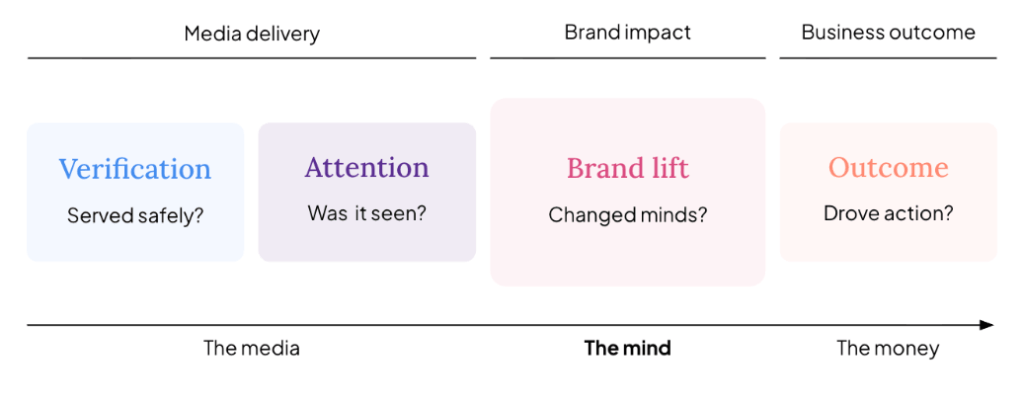
They are not delivery metrics. Impressions, viewability, verification and attention are genuinely real-time, but they tell you whether the campaign was served and seen, not whether it worked. Delivery is a prerequisite for brand impact, not a proxy for it.
They are not actions like sales, footfall or conversions. Those outcomes matter, but they are also shaped by factors beyond advertising.
Mid-campaign brand insights sit earlier in the journey, showing whether a campaign is changing what people know, feel and intend before those shifts translate into behaviour.
One more clarification matters: “mid-campaign” does not need to mean “instantaneous.” A weekly measurement cadence is often entirely sufficient to drive meaningful mid-flight optimisation.
Across Happydemics in-flight studies, the first response comes in as little as 24 hours after media exposure. From there, a statistically reliable read on core KPIs emerges once just 30% of responses are collected, with insights refreshed daily as new data comes in.
Why Mid-Campaign Brand Measurement Has Historically Been Hard
If in-flight brand measurement is so useful, why hasn’t it been standard practice? It isn’t for lack of investment. Eight in ten advertisers already use brand lift studies. The challenge is turning findings into decisions quickly enough to influence live campaigns. And confidence in existing approaches is fragile: IAB’s State of Data 2026 research, found that at least 60% of buy-side users say advanced measurement approaches fall short on timeliness.
That scepticism is well-founded, because three genuine problems stood in the way of mid-campaign brand measurement.
The first was a sample problem. Credible brand lift measurement depends on comparing a meaningful sample of ad recallers (people who recall seeing the campaign) against a comparable control group who don’t. Traditional survey fielding simply couldn’t assemble those samples quickly enough. By the time you had statistically usable groups, the campaign window had moved on — so measurement waited until the end, when the full sample was available.
The second was a methodology problem. Brand lift studies were designed around fixed campaign windows: field before or during, read out after. The architecture assumed one measurement moment, not a continuous series of them.
The third was an action problem. Even when early signals technically existed, reporting cycles buried it. Data went through processing, analysis, and deck-building, and insights surfaced weeks later…at which point they were history lessons, not decision inputs.
Each of these constraints has loosened and the barriers that made in-flight brand measurement impractical have, quietly, come down.
Why Brand Lift Is the Right Framework for Mid-Campaign Insights
Real-time signals can show whether people saw, clicked or completed an ad. They cannot tell you whether the campaign changed their minds.
Brand lift can. By comparing ad recallers with a control group of non-recallers, it isolates the campaign’s incremental effect real human responses including awareness, perception, consideration, preference and purchase intent.
That full-funnel view matters because brand outcomes do not always move together. A campaign may build awareness without strengthening consideration, or drive recall without improving preference. Brand lift reveals those gaps while there is still time to respond.
Because the same framework applies across channels, teams can compare brand impact consistently and see where the next pound of budget can work hardest.
In short, brand lift is the only direct, people-based way to see how a campaign is changing minds while it is still live.
What You Can Actually Do With Mid-Campaign Insights
The value of in-flight measurement is best understood through the decisions it enables. Mid-campaign optimisation isn’t one activity but several, and real-time insights into campaign performance feed each of them differently. Five use cases come up again and again.
Creative comparison and rotation. When multiple creatives are live, mid-campaign brand insights show which variants are actually moving brand outcomes, not just which are earning clicks. If one execution is driving recall and another is flat, you can shift weighting towards the performer weeks before a post-campaign report would have told you the same thing, after the fact.
Tip: the first few days of a campaign can be highly revealing. If ad recall sits five or more points below benchmark at the first in-flight reading — and creative KPIs such as interest and likeability are also weak — the issue is usually the creative itself and a rotation may be needed.
Channel mix rebalancing. In-flight measurement reveals which channels are driving the brand outcome you’re targeting. If CTV is lifting consideration while another channel is delivering impressions but little else, budget can be reallocated while the spend is still live — turning measurement into an active input to media planning rather than a retrospective audit of it.
Tip: when one channel posts an Impact Score of 60+ and leads the next-best channel by 15 points across multiple KPIs, it’s time to reassess the media mix. First, though, separate true channel strength from creative fit — the two often overlap.
Audience and targeting refinement. Campaigns rarely move every segment equally. Mid-flight read-outs identify where the campaign is genuinely shifting perception and where it’s falling flat, allowing targeting to be tightened — or a struggling segment’s messaging to be rethought — during the campaign window.
Market and geo comparison. For multi-market campaigns, in-flight insights show where the campaign is landing and where it isn’t. That might prompt heavier investment in a responsive market, or a localised creative adjustment in one that’s lagging, without waiting for the global wrap-up.
KPI re-prioritisation. Sometimes the signal isn’t about media at all, but messaging. If awareness is climbing but consideration isn’t following, the campaign is getting seen without giving people a reason to care — a cue to adjust the message mid-flight rather than discovering the disconnect in the post-mortem.
Tip: the same disconnect can surface in likeability: if people remember the ad but don’t enjoy it, the messaging tone, complexity or execution may be holding it back. Brand KPI data shows that Clarity and Likeability are 86% correlated. A confusing ad is rarely a liked one, and weak scores on both are a cue to reconsider messaging mid-flight.
What This Looks Like in Practice
Lenovo leveraged mid-campaign brand insights during its recent Yoga Aura Edition campaign in Sweden, using Happydemics new In-Flight measurement across social, online video and DOOH.
With the first results available by day six, the team removed an underperforming audience segment, turning the campaign around from below benchmark. Mid-campaign insights also reveleased room to extend online video after interest reached seven points above benchmark.
The campaign went from an average projected outcome to delivering a DOOH Impact Score of 64, consideration 11 points above benchmark and a 40.4-point uplift in Brand Image among ad recallers.
These were not recommendations saved for the next campaign. They were decisions made while the current one was still live.
When Mid-Campaign Insights Make the Most Difference
In-flight measurement is most valuable when there is enough campaign runway to act on the signal.
It works particularly well for long duration campaigns, where teams can make a change and observe what happens next. It is also well suited to multi-creative and multi-channel campaigns, where comparison is the engine of optimisation.
The value increases further during high-stakes moments like Lenovo’s FIFA world cup campaign, when uncertainty is high and the cost of discovering a problem after the fact is greatest.
For a very short tactical burst, such as a one-week promotional flight, a well-designed post-campaign brand lift study may be the better fit.
Mid-Campaign Insights as a Competitive Advantage
For the organisations that adopt them, mid-campaign brand insights compound into a genuine edge. And the bar is lower than it might appear. Only 15% currently say effectiveness evidence is the primary driver of budget decisions. Most budget-setting still runs ahead of, or apart from, the evidence on advertising effectiveness. Closing that gap is the advantage: campaigns get optimised faster, while spend is still live and can still be redirected. Less budget is wasted on underperforming creatives and channels, because underperformance is caught in weeks rather than diagnosed in retrospect. Creative learning happens during the campaign — feeding the work that’s live now, not just the brief for next year. And media teams, insight teams, and leadership operate from a shared, credible view of brand performance throughout the campaign window, rather than negotiating between delivery dashboards and gut feel until the wrap report lands.
How Happydemics Mid-Campaign Brand Insights work
Happydemics In-Flight is deliberately simple, activated in one click during brand lift study setup, with data collection running continuously and results updating throughout the campaign. More than 20 brand KPIs, spanning familiarity, recall, perception, consideration, preference and purchase intent, are measured and benchmarked so performance can be compared across creatives, channels, audiences, markets and strategies.
Happydemics In-Flight uses the same ad recaller-versus-control design as a standard brand lift study, preserving the credibility of the final measurement in every interim reading, complementing post-campaign measurement rather than replacing it.
For advertisers already optimising media in real time, continuing to measure brand impact retrospectively no longer makes sense. The opportunity is not simply to learn faster, but to act while budget, creative and targeting can still be changed, and while those decisions can still improve the campaign.
For more information on how in-flight works, book a demo with the Happydemics team.