Brands are activating across more channels than ever, but most brand lift studies still score each channel on its own. That leaves a crucial question unanswered: do these channels work better together than apart? As media plans add channels, the gap between joined-up activation and proof gets harder to defend.
Whether you can answer that depends less on the channels than on how you measure them.
A study built channel by channel can tell you which channel performed best. Only a study built across channels, using cross-platform advertising measurement, can tell you whether they performed better together, and whether the best combination changes with the objective. Below, we set out what each measurement approach can see, what it takes to measure synergy, and what happened when we tested it on a live campaign.
Multi-channel, cross-channel, omnichannel: why the difference decides what you can measure
These three terms get used interchangeably. They shouldn’t be, because each one implies a different measurement model, and only some of those models can see synergy at all.
| Approach | How channels are activated | What measurement can see |
|---|---|---|
|
Multi-channel |
Present on several channels, each planned, run and measured in isolation |
Each channel’s lift on its own, with no view of how channels interact |
|
Cross-channel |
A selected set of channels integrated through shared data and joined-up reporting, not necessarily every channel |
Combined lift across that set, and whether specific combinations outperform their parts |
|
Omnichannel |
Reverses the logic: organised around the customer rather than the channel, which in practice means the full relevant channel set, integrated |
Lift across the whole mix, and which combinations drive it |
That distinction matters because measurement inherits the structure of the activation.
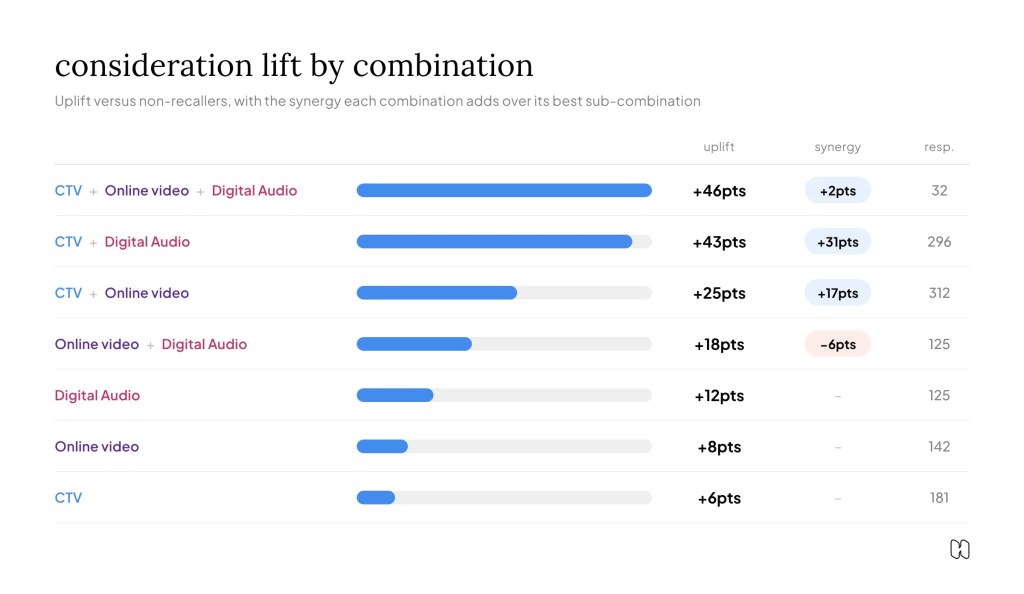
Single-channel and multi-channel studies score each channel separately, by design. There is no mechanism for spotting one channel lifting another. If CTV builds familiarity that makes an audio spot land harder, a siloed study splits that credit between two reports or loses it entirely.
Cross-channel and omnichannel measurement are the only approaches positioned to ask whether a combination is worth more than the sum of its parts. Put simply, for multichannel marketing and beyond, the measurement method has to match the activation strategy.
Industry usage of these terms varies, with some definitions built on channel count and others on customer-centricity; these are the working definitions for this article, not a ruling on that debate.
What it takes to measure channel synergy
Standard brand lift reporting can rank channels against each other. It can’t isolate synergy. Run a separate study per channel and each one has its own sample, its own timing and its own control group. Line four of those up side by side and you can say which channel did best. You can’t say whether a combination of three did better than the strongest of them alone, or by how much.
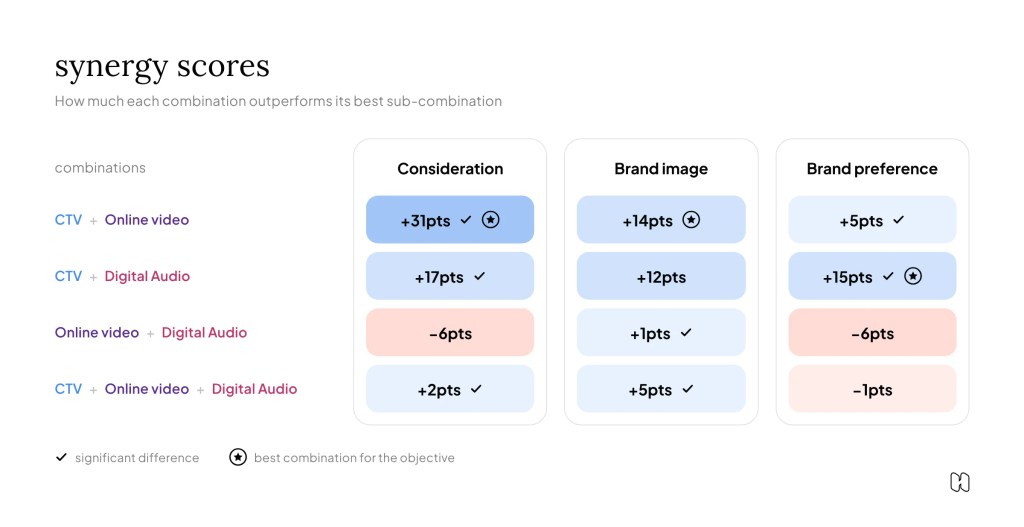
Measuring synergy takes three things:
- One survey across every channel. A single survey covering the full channel mix means respondents can be grouped by the combination of channels they actually saw, and every group compared against the same matched control. Everyone answers the same brand questions, so outcomes compare directly across groups.
- A control based on ad recall. Instead of comparing everyone served an ad with everyone who wasn’t, compare people who recall the ad with a matched group who don’t. That ties lift to ads that actually registered with people, not just ads that were delivered.
- A benchmark to read results against. Measure each channel and channel combination against a benchmark, so a lift figure can be judged in context, not in isolation.
With these three things in place, you can measure synergy against any objective across the funnel, from awareness and consideration through to preference and intent. This reveals which channel combinations work best for each objective, and where channels deliver more impact together than they do alone.
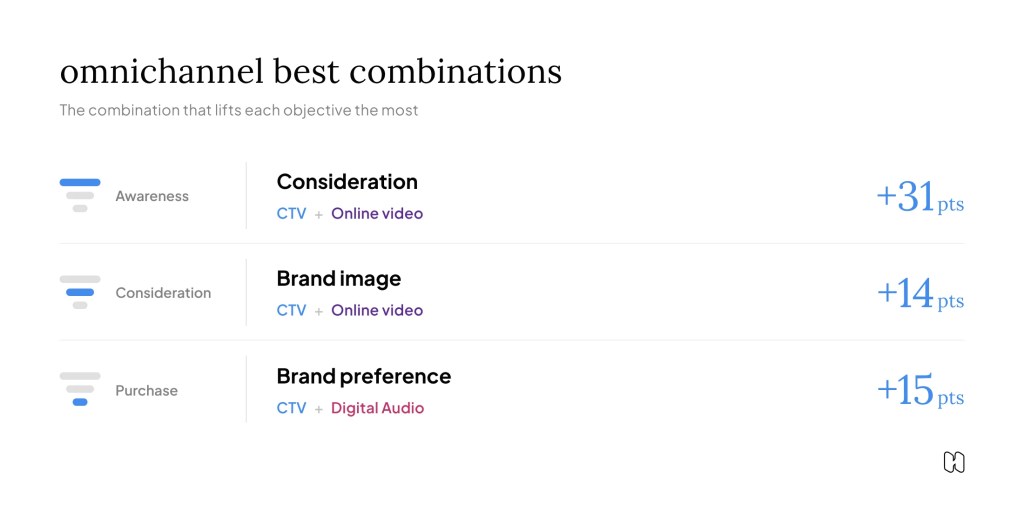
Ahead of our omnichannel brand lift launch in Q1 2027, we put this approach to work on a live campaign with The Trade Desk and Disney+ in France.
The test case: The Trade Desk × Disney+
What was tested
Disney+ France wanted to maximise brand impact through the competitive 2025 holiday season, and to learn which channel combinations delivered the strongest brand outcomes. The campaign ran nationwide on The Trade Desk’s Kokai platform across four channels: CTV, broadcaster video on demand (BVOD), audio and open online video (OLV). It included audio advertising brand lift as part of the combined measurement.
Rather than measuring brand lift through four siloed studies, Happydemics measured all four channels through one omnichannel survey. IP-validated ad recallers were grouped by the combination of channels they saw and compared with a statistically matched group of people who didn’t recall the ads. Three outcomes were tracked through brand perception measurement: brand image, brand preference and consideration.
By the definitions above, this was omnichannel measurement: the campaign’s full channel set, measured together and organised around the person (ad recallers) rather than the channel.
What the results showed
Key finding: In an omnichannel brand lift study run by Happydemics for Disney+ France on The Trade Desk, no single channel combination performed best on every metric. CTV + audio + OLV drove the largest uplift in brand image (+48 points) and brand preference (+38 points), while CTV + BVOD + OLV drove the largest uplift in consideration (+33 points). The best omnichannel mix depends on the brand objective, not on any one channel.
The campaign reached 7.5 million people and 6.8 million households across France, from nearly 17 million impressions. For each objective, the best-performing combination far outpaced the strongest channel on its own:
| Objective | Best combination | Uplift vs. non-recallers | Gain over strongest single channel |
|---|---|---|---|
|
Brand image |
CTV + audio + OLV |
+48 pts |
+31 pts over OLV alone (2.8×) |
|
Brand preference |
CTV + audio + OLV |
+38 pts |
+24 pts over audio alone (2.7×) |
|
Consideration |
CTV + BVOD + OLV |
+33 pts |
+24 pts over OLV or BVOD alone (3.7×) |
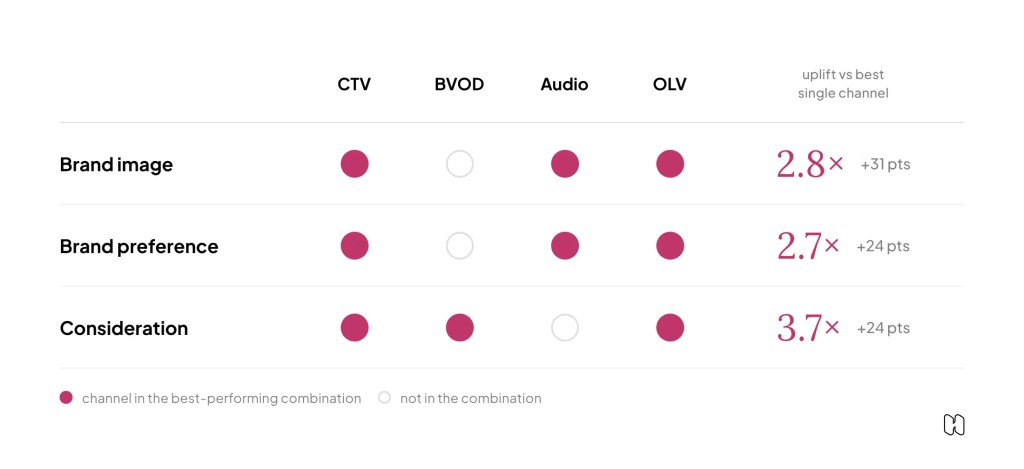
Every winning mix beat its best individual channel by at least 24 points. That’s synergy, measured rather than assumed. Because every group was measured against the same matched control, these are like-for-like comparisons. Each gain is calculated against the best-performing simpler setup in the same campaign, not against an empty baseline. The +31 points for brand image is the extra lift CTV and audio added on top of OLV, the strongest channel on its own.
But no single combination won on every metric. CTV and OLV appear in both winning trios; the swing channel is audio for image and preference, and BVOD for consideration. As Lavinia Benon-Stanescu, Data Partnerships Director at The Trade Desk, put it: “There wasn’t one channel combination that won across every brand metric.”
The best channel mix depends entirely on the objective. For Lionel Saguy, Paid Acquisition Senior Manager at Disney+ France, the value was “being able to combine a complex and intelligent setup with a survey to understand exactly the best performing combination.”
For the full breakdown, read the Disney+ case study or The Trade Desk’s write-up.
What this means for planners
Three practical lessons for planners looking to prove campaign impact come out of the data:
- Pick the objective before the mix. The combination that did most for brand image and preference was not the one that did most for consideration. A mix tuned for one KPI can leave points on the table for another.
- Don’t judge channels on solo performance alone. CTV wasn’t the strongest single channel on any of the three metrics, yet it sits in every winning combination. Some of a channel’s value only shows up in what it does alongside the others.
- Measure the way you activate. If the plan is built to work across channels, single-channel lift studies will report on the parts and miss the effect of the whole.
What comes next
The Disney+ study set out to show two things: that channel synergy can be measured rather than assumed, and that the right mix depends on the objective you’re optimising for. Both held.
In Q1 2027, Happydemics launches omnichannel brand lift measurement, bringing the approach behind the Disney+ study to brands planning their 2027 activations. For planners and brand leads, that means one study that tells you not just which channels are working, but which combinations are working, and for which goal. The brand metrics stay the ones you already track. What changes is that the results account for how your channels work together.
If you’re planning omnichannel activations for 2027 and want to know which mix will move your objective, get in touch with our team. In the meantime, read the full Disney+ case study.
Frequently asked questions
What is an omnichannel brand lift?
Omnichannel brand lift measures how much a campaign moves brand metrics such as image, preference and consideration. It covers the full relevant channel mix in one study instead of scoring each channel on its own. That means it can show which channels are working, and also which combinations are working and for which objective.
What’s the difference between multi-channel, cross-channel and omnichannel brand lift?
Multi-channel studies measure each channel on its own, so they can’t see how channels interact. Cross-channel measurement links a selected set of channels and can show whether specific combinations do better than their parts. Omnichannel measurement does the same across the full channel mix. Only cross-channel and omnichannel approaches can detect synergy between channels.
Is there a single best channel mix for brand lift?
No. Happydemics ran an omnichannel study for Disney+ France on The Trade Desk, and no combination won on every metric. CTV + audio + OLV drove the largest uplift in brand image (+48 points) and brand preference (+38 points). CTV + BVOD + OLV drove the largest uplift in consideration (+33 points). The best mix depends on the brand objective.
What is channel synergy in brand lift?
Channel synergy is when a combination of channels delivers more brand impact than any of those channels does alone. In the Disney+ study, every winning combination beat its strongest single channel by at least 24 points. For brand image, CTV + audio + OLV delivered 2.8× the lift of OLV alone, which was the strongest individual channel.
Why can’t separate single-channel brand lift studies measure synergy?
Each single-channel study has its own sample, timing and control group. Put side by side, they can rank channels against each other. They can’t show whether a combination did better than its parts, or by how much. To measure synergy, one survey has to cover every channel, so respondents can be grouped by the combination they saw and compared against the same matched control.
How did Happydemics measure brand lift in the Disney+ campaign?
One omnichannel survey covered CTV, BVOD, audio and OLV. IP-validated ad recallers were grouped by the channel combination they saw. Each group was compared with a statistically matched group of people who didn’t recall the ads. Because the control is based on recall, lift is tied to ads that actually registered, not just ads that were delivered. Results are read against a benchmark of more than 40,000 KPIs.
Why was CTV in every winning combination if it wasn’t the strongest single channel?
Some of a channel’s value only shows up alongside other channels. In the Disney+ study, CTV wasn’t the strongest solo channel on brand image, preference or consideration, yet it was part of every winning combination. Judging channels only on solo performance can undervalue the ones that make the rest of the mix work harder.
How should planners choose a channel mix for brand lift?
Start with the objective. In the Disney+ study, the mix that did most for brand image and preference wasn’t the one that did most for consideration. Then measure the way you activate. If the plan is built to work across channels, the study should be too, or it will report on the parts and miss the effect of the whole.
When is Happydemics launching omnichannel brand lift measurement?
Happydemics launches omnichannel brand lift measurement in Q1 2027, building on the study run with The Trade Desk and Disney+. Brands keep the metrics they already track, and the results also show how their channels work together.