
If you’re serious about improving advertising performance, ad campaign effectiveness measurement beyond basic metrics like clicks and impressions is crucial. What you really need is a deeper, universal, and sustainable evaluation of your impact: Brand lift.
Brand lift is an ad measurement tool that evaluates all the impacts generated by an ad on a brand or a product/service, including in audio environments, where podcast brand lift helps quantify impact without relying on clicks or visuals. It provides a clear understanding of the impact on brand perception at every stage of the funnel.
In a world governed by the effective use of data and marked by fragmented consumer journeys, Brand lift is the only measurement tool that allows you to know if your advertisement reached the right audience, how it was perceived, and what impact it had on your brand image.
With a unique methodology, you can activate a Brand lift across all media and in all regions of the world. By integrating this measurement tool into all your ad campaigns, you obtain a unified view of all your performance initiatives.
Adopting Brand lift means continuously optimizing your ad strategies and maximizing the return on investment for your clients.
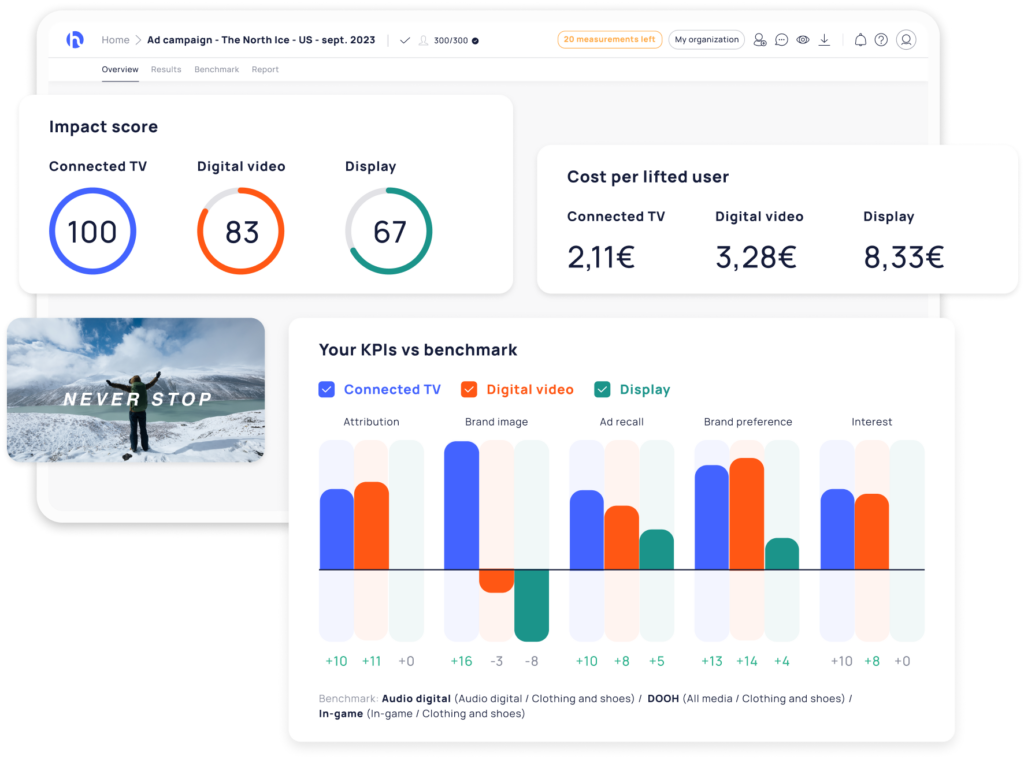
Here are some more details on the 4 good reasons to measure your ad performance with a Brand lift.
[lwptoc]
Reason #1: Better targeting improves advertising performance
A key factor that determines campaign effectiveness is the targeting accuracy. The success of an advertisement is built on whether it succeeds in reaching the right audience. Even the best creative in the world combined with a perfectly clear message won’t save a campaign if it has poor targeting.
The quality of your targeting is directly linked to your return on investment. The better your targeting, the better the chances of you generating meaningful ROI from ads.
This is where ad measurement becomes essential, particularly for channels like CTV, where CTV ad measurement helps validate whether advanced targeting truly reached the right audience. With the right advertising measurement indicators, you can identify to what degree your campaigns are reaching your core target.
Classic advertising metrics don’t give you this level of insight. Only advertising post-testing will allow you to get truly effective indicators when it comes to evaluation your targeting quality.
Among these performance indicators, ad recall rates are critical; they tell you what percentage of the population exposed to your ad actually remembered it.
Ad measurement also enables you to assess targeting quality by looking at whether the individuals exposed to your ads know your brand were active consumers in your market, or matched your intended profile.
Reason #2: Relevant messages drive stronger ad performance
By measuring how your audience perceives your ads, you’ll clearly see if your advertising message is resonating or if adjustments are needed to boost performance.
How can you make sure that your message has been received and understood as you intended by the people who’ve seen your ad? How can you measure your campaign’s creative effectiveness?
To answer these questions, you need to turn to the creative diagnostic carried out with the Brand lift.
Depending on your goals, it can be composed of several indicators that help you understand your ad performance in terms of consumer perception.
To do this, we measure 3 main KPIs:
Personal interest in the brand or product reflects the quality of the message and the distribution by its ability to attract attention and spark curiosity in the individuals exposed.
The approval score allows you to understand whether people appreciated or liked your advertisement.
The attribution rate evaluates the degree to which your campaign is correctly associated with your brand.
You can also get metrics which measure the message clarity of the ad, its perception, and even the interest in your brand or product.
Reason #3: Measuring ad performance reveals true brand impact
Measuring ad performance allows you to clearly identify how ads affect your brand, such as increasing purchase intent or improving brand awareness, beyond basic engagement metrics.
Once you know whether your targeting is doing what it’s supposed to, and whether your message has completed its objectives, you’ll then look to understand the impact generated for your brand.
The Brand lift analysis is based on the discrepancies between ad recallers and control group. For each indicator evaluated, we’ll compare the discrepancies in the results between these two populations. The more significant the discrepancies, the more we can consider that the brand impact is significant.
You won’t evaluate the same KPIs; you’ll tailor them to your goals. For example, if the aim of your campaign is to develop your brand awareness, you’re mainly going to keep an eye on the brand perception indicators.
If you’re looking to develop your sales, the product/brand consideration and purchase intent rates will be much more relevant.
Reason #4: Continuous measurement optimises future advertising performance
Launching a campaign means committing budgets, so, you can’t afford to multiply actions with a low ROI. The best way to avoid doing exactly that is to understand the strengths and weaknesses of your previous campaigns.
Thanks to the Brand lift, you’ll be able to identify optimization opportunities for your ads with greater precision.
By continuously measuring ad performance, you’ll pinpoint exactly what worked and what didn’t, enabling smarter investments and improved future campaign results.
Understanding these four critical reasons to measure ad performance will help you consistently deliver effective advertising campaigns. To learn more about comprehensive ad measurement solutions, speak with our experts.